John ‘Skip” Laitner is an economist, enjoying a desert year while on research sabbatical from the American Council for an Energy-Efficient Economy. Skip is uncovering some surprising insights from his time in the desert that inform the way one looks at the economy and social systems. In a series of posts entitled Desert Year, Skip lends us his insights, as well as his 40 years of experience as an energy and natural resource economist, to probe the economic, climate, and energy challenges that confront us.
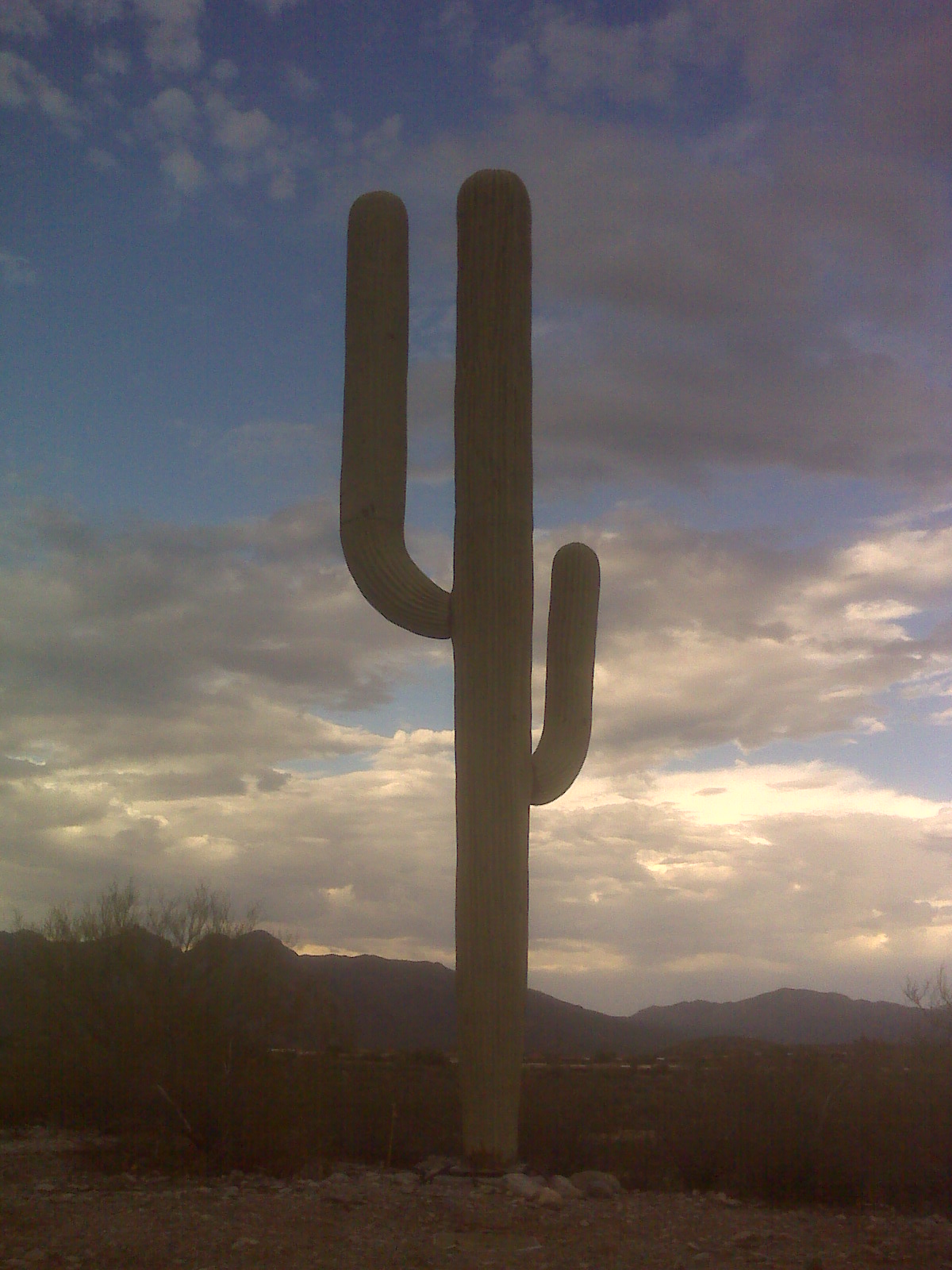
A Most Unnatural Cactus!

Unlike most economic statistics, this really caught my eye. A very tall and almost too perfect-looking giant saguaro cactus, perched very high upon the hill just outside Tucson. The desert sentinel. I wondered aloud whether it was real or perhaps artificial. My friend leaned over as we drove past and assured me that it might be unusually large but it looked quite real.
Still I wondered.
It took me almost six weeks later, this past weekend in fact, to actually find out. I was out for a late afternoon jaunt and I first started to scoot along on the road right past the cactus. But as I again looked up again I suddenly thought, why not turn the outing into a more of an adventure? So I decided to get up close and personal.
As I then detoured and surged the 200 meters up the hill, some of the details begin to unfold. About halfway up, yes, it began to look like the real thing. From about 30 meters away I spotted a couple of holes that might have been home to Gila Woodpeckers or Gilded Flickers. And I thought, why yes, it might actually turn out to be very real indeed.
But it wasn’t until I was perhaps 10 to 15 meters away that I saw the bolts that held it to its concrete footing, and as I pulled right up to it I spotted the several heavy wires that looked as though they might siphon off a very large current. I’m guessing it was nothing more than a very elegant lighting rod.
I am an economist, enjoying a desert year – very much in the tradition of naturalist Joseph Wood Krutch’s book, The Desert Year. He wrote it in the year just before he joined the University of Arizona faculty in 1952. I first read it in the early 1980s. And as I am slowly making the transition into a year-long research sabbatical with colleagues at the University, the “Desert Year” again informs my thinking. (more…)



 Follow our RSS feed